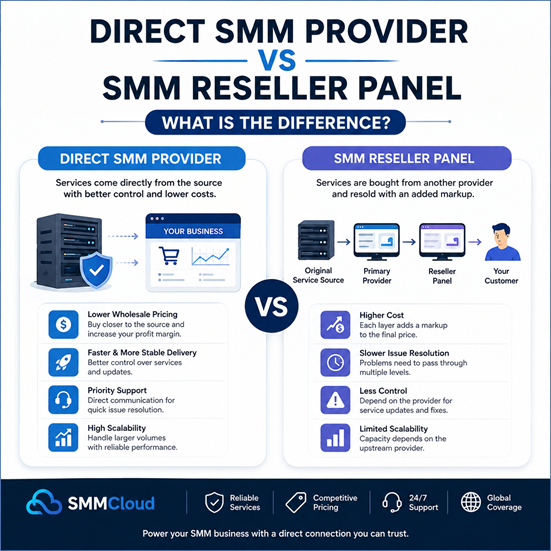
Direct SMM Provider vs SMM Reseller Panel: What Is the Difference?
The SMM industry includes thousands of panels offering followers, views, likes, comments, subscribers, watch hours, and other social media services. However, not every SMM panel operates in the same way.
Some platforms work mainly as reseller panels. They purchase services from other suppliers, add a markup, and resell those services to their own customers. Other platforms operate closer to the service source and position themselves as direct SMM providers.
For agencies, freelancers, and resellers, understanding this difference is important. It can affect pricing, service stability, order handling, support quality, and long-term profitability.
This guide explains how direct SMM providers and reseller panels differ, what advantages each model offers, and what resellers should consider before choosing a supplier.
What Is an SMM Reseller Panel?
An SMM reseller panel is a platform that allows users to purchase social media services and resell them to their own customers.
The panel usually provides a centralized dashboard where users can:
- Browse available social media services
- Submit orders
- Check order status
- Request refills or cancellations
- Add funds to their balance
- Connect their own website through an API
Many reseller panels do not operate the underlying services themselves. Instead, they connect to one or more external providers through API integrations.
When a customer places an order, the reseller panel may automatically send that order to another supplier. The reseller then earns money from the difference between the supplier’s price and the price charged to the customer.
This model makes it easy to start an SMM business without developing a complete fulfillment system from the beginning.
What Is a Direct SMM Provider?
A direct SMM provider operates closer to the original source of the services it sells.
Rather than relying entirely on several layers of other reseller panels, a direct provider may manage services directly, work closely with the original fulfillment source, or maintain greater control over service delivery and technical operations.
A direct provider may be able to offer:
- More competitive wholesale pricing
- Faster communication about service problems
- Better visibility into delivery behavior
- More direct control over service updates
- Faster handling of refill, cancellation, or technical issues
- Greater capacity for large-volume orders
The exact meaning of “direct provider” can vary between companies. Resellers should therefore evaluate actual service performance, support, pricing, and order handling instead of relying only on marketing labels.
SMMCloud is positioned as a direct SMM provider and reseller-ready platform for agencies, freelancers, and high-volume sellers who need a scalable source of social media services.
The Main Difference Between the Two Models
The biggest difference is the number of supplier layers between the reseller and the actual service source.
A typical reseller chain may look like this:
Original Service Source

        ↓

Primary Provider

        ↓

Reseller Panel

        ↓

Smaller Reseller

        ↓

Final Customer
Each additional layer may introduce:
- Another price markup
- Slower communication
- Less control over order problems
- More delays when services change
- Less accurate information about delivery conditions
A more direct supply chain may look like this:
Service Source or Direct Provider

        ↓

Reseller or Agency

        ↓

Final Customer
A shorter supply chain does not automatically guarantee perfect service. Social media platforms frequently update their systems, and service performance can change at any time.
However, fewer supplier layers can make pricing, communication, and problem resolution more efficient.
1. Pricing and Reseller Margins
Pricing is one of the most important differences for resellers.
A reseller panel usually purchases services from another supplier and adds a profit margin. When several panels resell the same service, each layer may increase the final price.
For example:
Original provider price: $0.50

First reseller price:    $0.65

Second reseller price:   $0.85

Customer price:          $1.10
A reseller buying closer to the source may receive a lower base price and retain more flexibility when setting retail prices.
This can help resellers:
- Compete more effectively
- Maintain better profit margins
- Offer volume-based pricing
- Create custom packages
- Adjust prices without losing profitability
However, the lowest price is not always the best choice. A cheap service with frequent drops, slow delivery, or poor support can create more refunds and customer complaints.
The best supplier is usually one that offers a reasonable balance between price, stability, delivery speed, and support.
2. Service Control and Updates
Social media services can change quickly. A service that works well today may slow down, experience drops, or stop working after a platform update.
A reseller panel that depends on another panel may not immediately know:
- Why an order is delayed
- Whether a service has stopped
- When delivery will resume
- Whether refill is possible
- Whether a new service version is available
The reseller may have to contact its provider, which then contacts another provider. This creates delays and incomplete information.
A supplier operating closer to the service source may be able to identify problems and update service descriptions more quickly.
This helps resellers make better decisions about:
- Temporarily disabling unstable services
- Replacing a service with a stronger alternative
- Updating estimated delivery speeds
- Informing customers about delays
- Processing refunds or refills correctly
3. Service Stability
No SMM provider can guarantee that every service will remain unchanged forever. Social media platforms continuously modify their algorithms, anti-spam systems, account verification rules, and engagement detection methods.
Service stability should therefore be evaluated through actual performance rather than absolute promises.
Useful factors include:
- Historical drop rate
- Delivery consistency
- Refill availability
- Average start time
- Completion speed
- Frequency of service interruptions
- Accuracy of service descriptions
- Provider response when problems occur
A direct provider may have more control over these factors, but resellers should still test services before sending large volumes.
A good practice is to place small test orders, monitor the results, and gradually increase volume only after the service performs consistently.
4. Support and Problem Resolution
Support quality becomes especially important when resellers process many daily orders.
Common problems include:
- Orders stuck in pending
- Incorrect start counts
- Partial delivery
- Drops after completion
- Duplicate orders
- Invalid links
- Private or restricted content
- Delayed cancellations
- Refill requests
When a reseller panel depends on another panel, support requests may pass through several layers before reaching the person or system that can solve the problem.
This can lead to vague responses such as:
- “The provider is checking.”
- “Please wait.”
- “The service is under maintenance.”
- “We are waiting for an update.”
A supplier with greater control over fulfillment may be able to provide clearer and faster answers.
For professional resellers, fast issue handling can be more valuable than saving a very small amount on the service price.
5. Delivery Speed and Capacity
Delivery capacity matters when a reseller serves agencies, influencers, large channels, or high-volume clients.
Some reseller panels are suitable for small orders but may struggle when several large orders are submitted at the same time.
A direct provider may have access to greater capacity and may be better able to manage:
- Bulk orders
- Large daily volume
- Multiple campaigns
- High-speed services
- Repeated API orders
- Orders from several reseller accounts
Resellers should not evaluate speed only from the advertised rate. They should also consider whether the supplier can maintain that speed during busy periods.
A service that delivers 100,000 units quickly once but frequently stops may be less useful than a service that delivers a stable daily volume.
6. API Reliability and Automation
Both direct providers and reseller panels may offer API access.
An API allows resellers to connect their own website or software to a provider. Orders can then be submitted and updated automatically.
Common API functions include:
- Retrieving the service list
- Checking the account balance
- Submitting new orders
- Reading order status
- Requesting refills
- Requesting cancellations
The presence of an API does not prove that a panel is a direct provider. Many reseller panels simply forward API orders to another supplier.
For resellers, the more important questions are:
- Does the API respond consistently?
- Are service IDs stable?
- Are order statuses accurate?
- Are price changes updated correctly?
- Can the provider handle high request volume?
- Is technical support available when integration problems occur?
Reliable automation is essential for businesses processing large numbers of daily orders.
7. Service Variety
Reseller panels often combine services from several external suppliers. This can allow them to display a very large service catalog.
A direct provider may have fewer services but greater control over the services it operates.
Neither approach is automatically better.
A large catalog is useful when customers need many different platforms and service types. However, thousands of poorly maintained services can make it difficult for resellers to identify reliable options.
Quality control is often more important than the total number of services.
When reviewing a provider’s SMM services, resellers should focus on:
- Clear service descriptions
- Accurate minimum and maximum quantities
- Realistic speed estimates
- Refill and cancellation terms
- Target country or region
- Supported link format
- Current service availability
8. Transparency
A reliable supplier should clearly explain what each service includes.
Important information may include:
- Start time
- Estimated speed
- Refill period
- Drop expectations
- Cancellation availability
- Supported link type
- Geographic targeting
- Account quality
- Minimum and maximum order quantity
Resellers should be cautious when a provider makes unrealistic claims such as:
- Every service is completely non-drop
- Every order starts instantly
- Every service is organic
- Every order is guaranteed forever
- Every platform is completely safe
Service conditions vary, and social media platforms can change without warning.
Clear limitations are usually a sign of more responsible service management.
Direct Provider vs Reseller Panel Comparison
FactorDirect SMM ProviderSMM Reseller PanelSupply chainCloser to the service sourceOften purchases from another providerPricingMay offer lower wholesale pricingUsually includes an additional markupService controlPotentially greater controlDepends on external suppliersSupportMay resolve issues more directlyMay need to forward problemsCatalog sizeMay focus on controlled servicesCan combine many external servicesAPIMay connect directly to fulfillmentMay forward orders through another APIScalabilityOften suitable for larger volumeDepends on upstream supplier capacityService updatesPotentially fasterMay be delayed by supplier communication
This comparison describes common industry patterns. Individual providers may operate differently.
Which Option Is Better for Resellers?
A direct provider is often a stronger choice for resellers who need:
- Better wholesale pricing
- Higher daily order capacity
- Faster issue resolution
- More stable supplier relationships
- Long-term API integration
- Greater control over profit margins
A reseller panel may still be useful when it offers:
- A specialized service unavailable elsewhere
- A convenient payment method
- Strong support
- A unique regional service
- A carefully selected catalog
- Reliable performance from multiple sources
Many experienced resellers use one primary provider and maintain one or two backup suppliers. This reduces dependence on a single source while keeping the main workflow simple.
Using too many suppliers can create another problem: inconsistent prices, duplicated services, difficult order tracking, and more complicated customer support.
How to Choose a Reliable SMM Supplier
Before connecting a provider to your business, evaluate the following:
Test Service Performance
Place small orders and monitor start time, delivery speed, completion, and drops.
Review Service Descriptions
Make sure the provider clearly states link requirements, speed, refill conditions, and limitations.
Check Support Responsiveness
Ask a practical question and evaluate whether the answer is clear and useful.
Compare More Than Price
Consider reliability, support, delivery capacity, and long-term consistency.
Avoid Unrealistic Guarantees
No provider controls the social platforms themselves. Absolute guarantees should be treated carefully.
Test API Stability
For automated businesses, check whether order creation, status updates, and balance data work consistently.
Review Refund and Refill Policies
Understand what happens when an order cannot be completed or a refill fails.
Final Thoughts
The difference between a direct SMM provider and an SMM reseller panel mainly comes down to the supply chain, service control, pricing structure, and issue-handling process.
A reseller panel can make it easy to start selling social media services. A direct provider can provide a stronger foundation for businesses that need competitive pricing, large-volume fulfillment, and more direct support.
The best choice is not simply the provider with the cheapest price or the largest catalog. Resellers should choose a supplier that offers a sustainable combination of:
- Competitive pricing
- Reliable services
- Clear descriptions
- Responsive support
- Scalable order handling
- Transparent refill and cancellation policies
SMMCloud provides a reseller-ready platform for agencies, freelancers, and social media service sellers. You can review the available services or create an account to start building your reseller workflow.